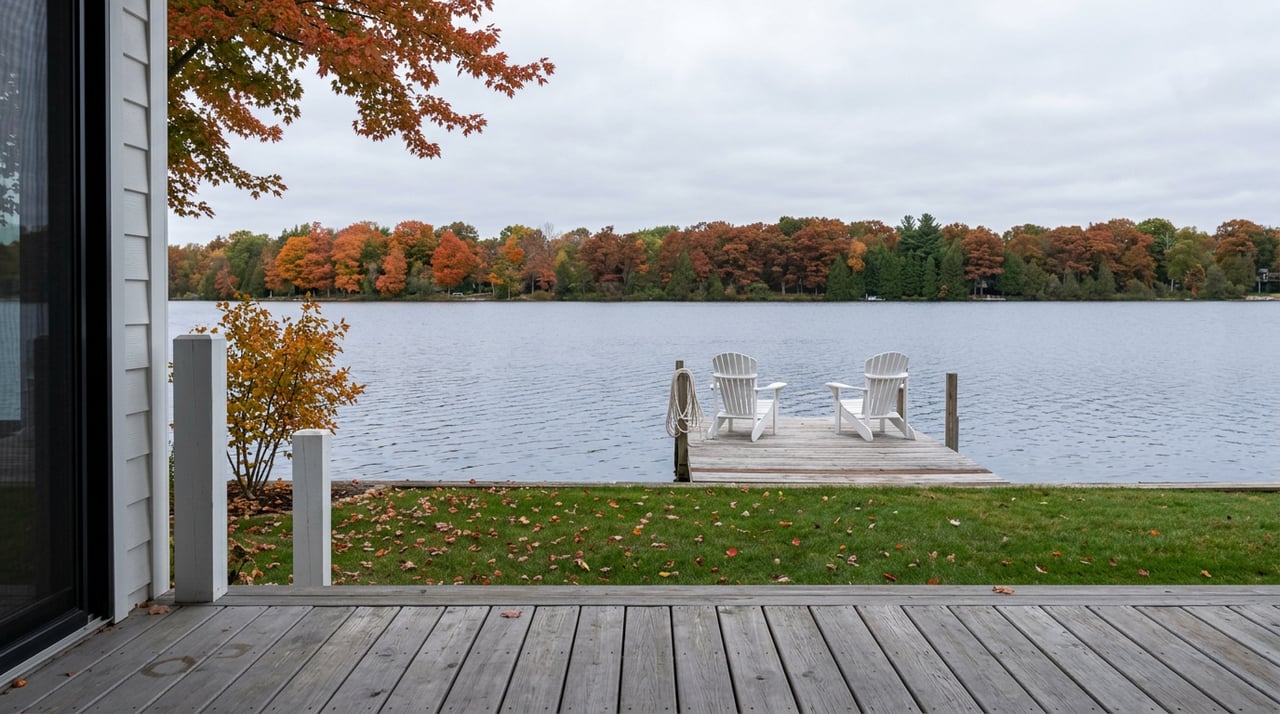
Walk the boardwalk at Palmer Park enough times and you stop looking down. You watch the river, you watch for the next laker easing past the sandbar, you watch your dog sniff at the same bench post it always sniffs. What you stop noticing are the brass markers set into the planks beneath your feet, 22 of them, each one naming a ship that has passed this stretch of the St. Clair River since before Michigan was a state.
That is the first way this town tells its freighter story. The second way costs a ticket and happens indoors, a few hundred feet from the boardwalk, inside a 370-seat theater that spent its summer on Broadway revivals and is about to spend a Sunday afternoon in October on shipwrecks instead. Most residents have only ever experienced one of these two versions. This fall is a good time to catch both.
The story under your feet
The Freighter Walk went into the boardwalk in the spring of 2022, a project of the St. Clair Leadership Team designed to give freighter watchers something to read while they wait for the next 1,000-footer to round the bend. Each brass marker gives a ship's name, build year, and length, and the range is the point. At one end is the Le Griffon, a 40-foot barque built in 1679 that carried a crew of 32 up the St. Clair River, through Lake Huron, and into Lake Michigan on what is generally regarded as the first sailing ship to work the upper Great Lakes. At the other end is the Paul R. Tregurtha, built in 1981 and stretching 1,013.6 feet, the longest vessel that currently sails the Great Lakes. Stand at Palmer Park long enough and you can watch a ship nearly as long as three football fields pass within 125 feet of where you're standing, close enough that the scale stops being abstract.
That proximity is the reason Palmer Park's boardwalk carries the title of the world's longest freshwater boardwalk, a half-mile run along a 5.90-acre park that slopes down to the river. It's a claim locals repeat so often it can start to sound like civic boilerplate, but the Bridge to Bay Trail's description of the riverwalk backs it up with the same framing the Chamber uses: a half-mile boardwalk built for exactly this kind of freighter watching, sculptures and gardens included. The brass markers didn't change the boardwalk. They gave it a reason to slow down and read instead of just walk through.
Same subject, different building
A few blocks from Palmer Park sits the Boardwalk Theatre at 109 South Third Street, a 370-seat venue that has spent the past several months proving it can hold a full Broadway-style season in a small river town. This summer's run included My Fair Lady and Footloose. What comes next is where the freighter story picks up again, in a completely different register.
On September 20, a string quartet from the Detroit Symphony Orchestra takes the Boardwalk Theatre stage for an afternoon performance, tickets running $30. Then the calendar turns toward something bigger: Chicago the Musical runs four performances on September 26 and 27 and again October 1 and 2, at $38 a seat. That's the theater doing what it has done all year, importing polished, ticketed entertainment to a town most people associate with fishing boats and Adirondack chairs.
Then, on October 25 at 3 p.m., the season pivots hard into the town's own maritime identity. Ric Mixter, a Great Lakes shipwreck researcher who has logged dives on more than 100 wrecks including the Edmund Fitzgerald and produced programming for PBS and the Outdoor Channel, takes the same stage for a $30 presentation. It's the same freighter subject matter sitting under the boardwalk's brass markers, now delivered as narrated history instead of a name and a date stamped into a plank.
Two ways to learn the same history
| Freighter Walk (Palmer Park) | Ric Mixter presentation (Boardwalk Theatre) | |
|---|---|---|
| Cost | Free, always open | $30 ticket, one afternoon |
| Format | Self-guided, 22 brass markers | Narrated talk with video and photos |
| Scope | Ship names, build years, lengths | Shipwreck research, including the Edmund Fitzgerald |
| Time commitment | A few minutes or a full stroll | Roughly two hours, October 25 at 3 p.m. |
| Setting | Outdoors, riverside, half-mile boardwalk | Indoors, 370-seat theater |
The two aren't competing for the same afternoon. They're complementary entry points into a subject the town clearly hasn't gotten tired of. If you've walked past the brass markers a dozen times without stopping, the Mixter talk is the version that finally makes the names mean something. If you've never made it to a Boardwalk Theatre show, the freighter markers are the free preview.
What else fills the calendar between now and Halloween
The freighter thread isn't the only thing moving on St. Clair's fall calendar. On September 18, the American Legion holds a memorial ceremony at Memorial Park honoring Medal of Honor recipient Dewayne T. Williams, a reminder that Palmer Park's neighbor green space carries its own history alongside the boardwalk's. St. Clair High School's homecoming parade runs through downtown later in September, starting near 9th and Vine and finishing on Trumbull, one of the small annual rituals that makes a town of this size feel smaller still.
October brings the season's real shift. The St. Clair Chamber's calendar lists window painting, balloon animals, and face painting downtown on October 3, a Trick & Treat Trail at Greig Park on October 10, and trick-or-treating for tots in the downtown plaza on October 21, hosted by the St. Clair Recreation Department. For the adults, War Water Brewery hosts its costume party later in the month, one of the few nights downtown where the boardwalk's usual freighter-watching crowd trades binoculars for costumes.
None of this is a coincidence of scheduling so much as a pattern. St. Clair spends its summers as a boating and freighter town, then spends its falls layering ticketed arts programming and neighborhood-scale traditions on top of that same identity without ever fully setting it aside. The Mixter talk in late October is proof the town doesn't treat its freighter history as a summer-only attraction. It's a year-round fact of living here, told once in brass under your feet and once more, a few weeks later, from a stage.
Why this matters if you already live here
If you've lived in St. Clair for any length of time, you've probably given a visiting relative the short version of the boardwalk tour: point at the river, mention the freighters, maybe stop at the Voyageur for a view from the patio. The Freighter Walk markers give that tour a second layer, actual names and numbers instead of a general wave toward the water. The Boardwalk Theatre's October booking gives it a third. Between the two, this is the fall to finally read what's under your feet before you buy a ticket to hear it explained from the stage.
For residents thinking about what a house near this stretch of river is actually worth beyond the number on a listing, that layered identity, working harbor and small-town arts scene sharing the same half-mile of boardwalk, is part of what buyers are paying for when they choose St. Clair over a quieter inland township. Great Lakes Realty and Property Management works this stretch of the county regularly, from the boardwalk district out toward the township's newer subdivisions, and we're always glad to talk through what a specific block or price point looks like here. If you're weighing a move within St. Clair or just curious what your own home might be worth in a town that still reads its own history off brass plaques, reach out for a free home valuation and let's turn the next page together.